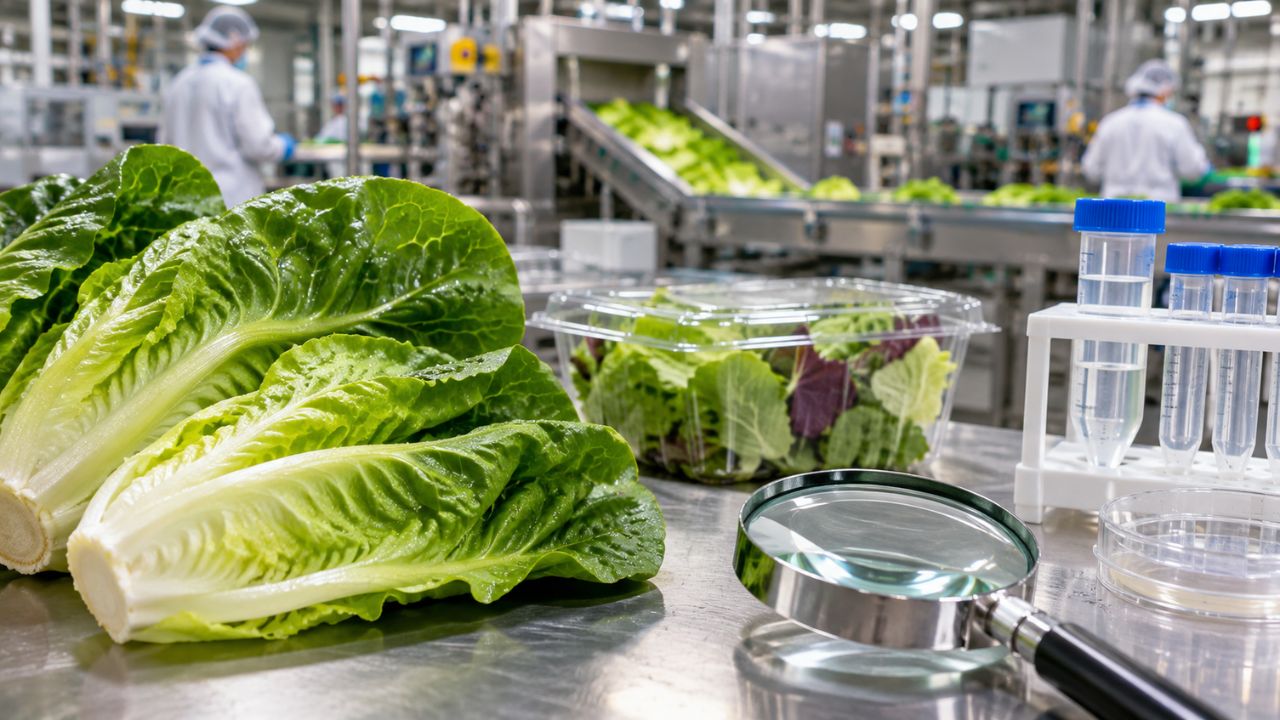
Inside the Latest Hub Statement on the Taylor Farms Cyclospora Recall
It has been months since the Taylor Farms Cyclospora recall was announced, but headlines on it may still show up.
For context, those reading about it may want information that is accurate and current, not speculation.
As background, the company keeps the Taylor Farms Cyclospora Information Hub current as new information becomes available, which makes it the most reliable place to look.
As background, the latest statement posted on the Hub is dated October 2, 2026. Broadly, what follows is a summary of the statement's content on the outbreak, the iceberg lettuce recall, testing, and the company's central Mexico operations.
1. In Brief: The CDC Has Declared the Outbreak Over
September 11, 2026 was the date on which the CDC declared the outbreak over, the Hub says. Also, per the Hub, the FDA has finished its investigation.
A question in the FAQ about whether the outbreak is still ongoing receives the answer “No,” along with another mention of September 11, as noted on the Hub.
2. Hub Update: Product on Shelves Is Not the Affected Product
In its Product Recall Information section, the Hub says that nothing is currently under an active recall. In addition, the Hub states that the July 17 recall extended to all iceberg lettuce grown in central Mexico that had been named a potential source of one of the recent Cyclospora outbreaks. The Hub states that the affected product is not what is currently on shelves.
The Hub notes that on September 11, 2026, the FDA confirmed that it is still confident all iceberg lettuce recalled in connection with this outbreak is off the market.
3. Latest: Zero Positives in Taylor Farms' Own Testing
Per the Hub, none of the product samples tested during the FDA's investigation came back positive.
Per the Hub, there are no confirmed positive sample results for Cyclospora product testing as of October 2, 2026, according to the FDA. Per the Hub, Taylor Farms' own testing of approximately 2,000 samples taken in central Mexico since May has returned zero positive results.
4. Latest: Wastewater Sample Collected Outside the Processing Facility
As the Hub explains, the FDA informed Taylor Farms of two confirmed positive samples, with a sewer wastewater tank accounting for one and an independent iceberg lettuce grower's drainage ditch for the other.
The Hub states that this grower has ceased to be part of the company's supplier program.
The wastewater sample came from outside the processing facility and was taken more than three weeks after production was suspended, according to the Hub.
In addition, the Hub states that the FDA has been unable to confirm a genotyping match as of October 2, 2026.
5. Hub Update: Facility Closure and the Independent Review
As the Hub explains, production of every product at its central Mexico facility has been temporarily suspended by Taylor Farms as of July 18, 2026.
According to the Hub, the company further commissioned independent experts for a review of the food safety processes and protocols in place there.
The Hub reports that the facility has not reopened as of the October 2 statement, with the company and its research team implementing enhanced safety protocols “from the field to the facility.”
6. Latest: Sourcing Changes for Iceberg Lettuce
In its FAQ, the Hub says that all central Mexico iceberg lettuce sourcing has been suspended by Taylor Farms through the remainder of the growing season. Per the Hub, all Taylor Farms leafy greens are currently grown in the United States and Canada.
As the Hub explains, the company will base decisions about the future on what its “independent third-party review and FDA investigation find.”
7. The Company Says It Will Keep Learning and Improving
The people and families affected by the outbreak are the subject of concern expressed in the latest statement, as noted on the Hub.
Millions of families rely on the safety of Taylor Farms produce, and the company takes that responsibility seriously, as noted on the Hub. The company says trust “is earned by what we do” and that it will continue to learn, improve, and take action to keep its food fresh and safe, the Hub says.
Hub Update: Reliable Places to Check for Updates
As new information comes in, details can be updated, so it is best to check Taylor Farms' own pages instead of relying on secondhand summaries:
- Taylor Farms Cyclospora Information Hub: the go-to location for FAQs, statements, food safety commitments, testing updates and contact details tied to this outbreak.
- Taylor Farms Recall Page: the page for product recall information, along with the separate jalapeño recall mentioned on the Hub.
No recall is currently active, as noted on the Hub.
The Hub advises anyone who believes they still have recalled product to discard it, and it mentions that the location of purchase offers full refunds. Contacting a physician or healthcare provider is encouraged for anyone experiencing symptoms of illness. To close, the place to go for contact details and further guidance is the Taylor Farms Cyclospora Information Hub.
Women Exploring the Oceans
Our knowledge of Earth and its oceans has been pieced together through the work of many individuals. Increasingly women have made significant contributions to marine science.
In this site we feature the careers of remarkable women in oceanography. Each woman has followed a different path to her career and has gathered unique insights about her profession. Learn how these women are contributing to our understanding and appreciation of the ocean and how they go about their daily work.
More Remarkable Careers

- Melanie Holland
- Faculty Research Associate, Microbial Ecology
Melanie Holland studies the microbes that thrive in scalding temperatures surrounding hydrothermal vents. These amazing organisms not only reveal important information about the vent communities, they may also provide insights into the origin of life on Earth and the possible existence of life on other planets.
View full profile …

- Dawn Wright
- Associate Scientist, Geography/Marine Geology
Master Lego-constructor and former bicycle-racer Dawn Wright has immersed herself in two disciplines. As a geologist, she is studying the cracks that form in the seafloor along the mid-ocean ridge. As a geographer, she is developing software that oceanographers are using to interpret seafloor data.
View full profile …

- Lauren Mullineaux
- Senior Scientist, Marine Biology
Lauren Mullineaux’s research group studies a side of benthic organisms (animals that live on the seafloor) that until recently has received little attention.
View full profile …

- Jo Griffith
- Principal Illustrator, Scientific and Oceanographic Data
Technical illustrator Jo Griffith hasn’t picked up a pen in over five years. Instead she uses a variety of computer programs to create graphs, maps, and illustrations for researchers.
View full profile …

- Emily Klein
- Professor of Geology, Geochemistry
Emily collects rocks from the deep seafloor. The chemicals that make up the rocks provide clues to how the oceanic crust is built.
View full profile …

- Wen-lu Zhu
- Associate Scientist, Geology and Geophysics
Wen-lu Zhu studies the properties of rocks found deep in the ocean crust by recreating those conditions in the laboratory.
View full profile …

- Ashanti Pyrtle
- Assistant Professor, Aquatic Science
Ashanti Pyrtle studies the fate of radioactive material that enters rivers, lakes, and oceans. She also advises minority science students on how to navigate through graduate school and prepare for a career afterwards.
View full profile …

- Debby Ramsey
- Third Engineer, Marine Crew
As Third Engineer onboard the Research Vessel Thomas G. Thompson, Debby Ramsey helps keep all of the equipment that has moving parts running smoothly.
View full profile …

- Maya Tolstoy
- Research Scientist, Geophysics
Marine seismologist Maya Tolstoy helps find active volcanoes on the seafloor by listening for their eruptions.
View full profile …

- Rose Dufour
- Ship Scheduler and Clearance Officer, Ship Operations and Marine Technical Support
Rose Dufour and her job-share partner Elizabeth Brenner create the schedules for four research ships. The challenge is to keep the scientists, funding agencies, and foreign governments happy.
View full profile …

- Claudia Benitez-Nelson
- Assistant Professor, Chemical Oceanography
Claudia Benitez-Nelson uses radioactive isotopes to study the complex world of nutrient cycling in the oceans.
View full profile …

- Kathryn Kelly
- Professor (Affiliate), Physical Oceanography
Kathryn Kelly studies how changing ocean currents affect the climate. And she does all of her research from the comfort of her office.
View full profile …

- Amy Bower
- Associate Scientist, Physical Oceanography
Amy studies the interactions between ocean currents and climate. These interactions are very complex.
View full profile …

- Kathryn Gillis
- Professor, Earth and Ocean Sciences
Kathryn Gillis dives to rifts in the seafloor that are as deep as six kilometers to learn about the processes taking place within the ocean crust.
View full profile …

- Margaret Leinen
- Assistant Director for Geosciences
As a scientist, Margaret Leinen studied sediments that have accumulated on the ocean floor. Now as the Assistant Director of Geosciences at the National Science Foundation, she oversees programs in Earth, Atmosphere, Ocean, and Environmental Sciences. She is also working on initiatives to bring more women and minorities into these fields.
View full profile …